
Why Pre-Emergent Fails in Tulsa and Northeastern Oklahoma Lawns (And How to Prevent It)
- Seth Newell
- Feb 13
- 3 min read
If you’ve applied pre-emergent and still see weeds in your Tulsa-area lawn, the product likely isn’t the problem.
When homeowners ask why pre-emergent fails in Oklahoma lawns, the answer is rarely random. It is usually a timing, soil, coverage, or chemistry issue specific to our region.
Understanding those variables separates seasonal frustration from long-term control.
Why Pre-Emergent Fails in Oklahoma Lawns
In northeastern Oklahoma, weed pressure is high and environmental swings are common. Even small miscalculations compound over time.
Most failures fall into one of seven categories.
1. Applied Too Late During Spring Warm-Up
The most common issue is late application.
Spring crabgrass germination begins as soil temperatures approach 55°F. In Tulsa, late-winter warm spells can accelerate this window quickly.
Once germination begins, pre-emergent will not eliminate seedlings.
Visible weeds indicate the barrier was applied too late. For a full breakdown of soil temperature thresholds and exact seasonal windows in Tulsa and surrounding areas, review: When to Apply Pre-Emergent in Oklahoma (Spring & Fall Timing Guide).
2. Applied Too Early
Applying too far ahead of germination shortens the effective protection window.
Tulsa-area clay soils retain moisture and heat differently than sandy soils. Early application during cold stretches can misalign the residual period with peak germination.
More product does not solve poor timing.
Precision does.
3. Mode of Action Dependency
Long-term reliance on the same chemistry weakens performance.
In Bermuda-dominant Tulsa lawns, repeated use of a single Mode of Action (MOA) can gradually select for resistant weed populations.
This appears as:
Increasing seasonal breakthrough
Patchy survival in high-sun areas
Declining consistency over multiple years
Rotation protects long-term efficacy.
For a full breakdown of product strategy, review: Best Pre-Emergent Herbicides for Oklahoma Lawns: What Actually Works Long-Term
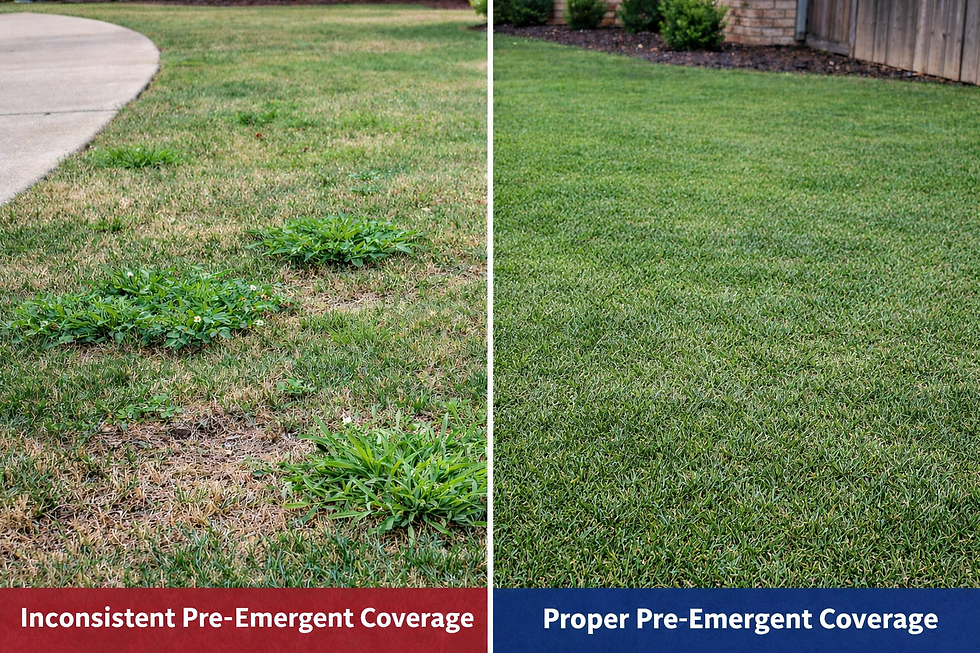
4. Inadequate Coverage or Calibration
Pre-emergent works by forming a uniform soil barrier.
If spreaders are miscalibrated or rates are reduced, gaps form. In Tulsa subdivisions with irregular lot shapes and narrow side yards, inconsistent coverage is common.
Weeds exploit those gaps.
Barrier integrity depends on proper rate and uniform distribution.

5. Soil Structure and Compaction
Pre-emergent performance depends on soil contact and activation.
Heavy clay soils common in Tulsa are prone to compaction. Compacted zones restrict water movement and create uneven incorporation of herbicide into the upper soil layer.
Thin turf and compacted areas also reduce density, increasing vulnerability to breakthrough even when chemistry is correct.
Long-term weed suppression improves when soil structure supports uniform moisture movement and root development.
Soil testing and compaction assessment can identify structural limitations that influence herbicide performance.
6. Tulsa Weather Variability
Tulsa weather is rarely stable.
Heavy rainfall can shift product placement in compacted clay soils. Extended dry periods delay activation if irrigation is not applied.
Rapid temperature swings influence germination timing more than most homeowners expect.
No pre-emergent is weather-proof.
Disciplined timing reduces risk.
7. Skipping Fall Applications
Many Tulsa homeowners focus only on spring.
Winter annual weeds germinate in mid-September as soil temperatures decline toward 70°F. If fall applications are skipped, those weeds establish before winter.
Spring applications cannot undo fall neglect.
What appears to be spring failure often began the previous autumn.
How to Prevent Pre-Emergent Failure in Tulsa
For Bermuda and zoysia lawns in Tulsa, Owasso, Bixby, Collinsville, and surrounding communities:
Monitor soil temperature — not the calendar
Apply before 55°F in spring and near 70°F in fall
Use full-label rates with calibrated equipment
Rotate Modes of Action over multiple seasons
Address compaction and structural soil limitations
When these variables are controlled, pre-emergent becomes predictable.
Not flawless.
But stable.
Bottom Line
If you’re wondering why pre-emergent fails in Oklahoma lawns, it is rarely a product issue.
It is usually a timing, coverage, soil structure, or rotation issue.
If performance has declined despite annual applications, the solution is not necessarily more chemistry — it is better structure.
Precision creates predictability.
Request Work Now


Comments